Wednesday, August 21, 2013

Accurate Rifle Marksmanship Pt. 5 Bore Conditions

     Let's stay on target while I'm on a roll today.  I just posted up Pt. 4 not long ago, but while I was in the process of gathering my data for part 4, an ugly thing reared it's head and smacked my precision accuracy down like an electric fly-swatter.

     The rifle bore (that's the inside of the barrel that the bullet goes through, for the newer folks to this sport) is one of the main things to consider when we start talking about precision accuracy.  Without going too deeply into advanced internal and transitional ballistics, let's just say that the internal condition of the rifle bore changes over time.

Here's what you can expect from a standard of the shelf rifle bore over time.

1.  "Virgin" =  Brand new.  Less than 5 shots through it. (Some factories do this for Quality Control)
2.  "Broken In" = Has over 60 or 70 shots through it.  Has been cleaned.
3.  "Seasoned" or "Equilibrium" =  THE sweet spot.  The most accuracy that your barrel bore can give you.
4.  "Excessive Fouling" = Accuracy drops off quickly.  Groups go haywire.

     There are 8 million ways to "break in" a rifle barrel and I doubt that too many rifles chambered in .22lr will even have a recommendation for breaking one in.  Most bore and barrel "break in" procedures are done for rifles that are being put to use for long (0-800m) and extreme long range (1000m+) applications.  I actually have a blog posting (not necessarily for the ARM series) that shows how I broke in my XLR rifle.

     What you need to know is that it isn't "necessary" to break in a rifle barrel.  They tend to break themselves in, over time, anyhow.  Could it hurt to take a little time and break one in?  Heck no.
But I honestly didn't break in the Mossy 702.  I just cleaned it up really good, took it out and started throwing copper. ALWAYS clean a brand new bore or a bore unknown to you.  You never know where it has been.

     My Cleaning Regimen:
   
     I clean a brand new barrel very aggressively with Hoppes #9 mild solvent and a bore brush.  A new barrel WILL have some type of lubricant/preservative in it from the factory.  It will also have machining imperfections that you can not see.  Going after it with some applied and controlled aggression and a bore brush gets that gunk and junk out of the bore and might smooth some of those imperfections out a little bit, whether you can see it or not.

    **Claymore's Recommendations**  Use a coated 1 piece cleaning rod...NOT the 3 piece rods that come in most inexpensive cleaning kits.  They have a tendency to break at the worst possible moment and ruin things like the bore, the crown, the throat.
     Also, be VERY careful around the Crown (the very end) of your muzzle and the Throat (the part just before your bore starts in the receiver end...where the bullet goes IN).  It's not hard to damage those two areas.  Be careful.

     So, new barrel, soak a patch in mild solvent like Hoppes #9, run it slowly through the barrel and then back again, once or twice.  We are trying to make sure that the bore is saturated with solvent.  Let the barrel sit/soak for a few minutes.  Now we put the brush on our rod and get busy with about 5 strokes in each direction, being careful around the crown and throat areas.
**Side note, some folks do NOT like to go backwards (muzzle to receiver) with their brush or patch.  It is all personal preference as long as you are careful.

     After the brush, run patches through the bore until they come out clean and dry.  It could take 3, it could take 13.  After they run clean, you are good to go do some shooting.

     At around 60 shots or so I will clean the bore again.  I will clean it the same as the first cleaning.  Aggressive, yet careful.

     After that, I won't introduce ANYTHING into the bore of that rifle until such a time as I see that my shot groups going in the wrong direction....when they get worse it is time to clean it.   .22lr isn't the cleanest cartridge ever developed, that is for sure.  There's quite a bit of residue left in the barrel, so on and so forth.

     Accuracy IMPROVES as the bore develops "fouling".  Each time the bullet goes down the barrel, it leaves some copper fouling and some powder fouling in its wake.  Some fouling is GOOD for a bore.  It builds on the walls of the bore, decreasing the area around the projectile and increasing the pressure pushing the bullet without escaping around it as much.

     Real world scenario that I encountered while doing the testing for Pt. 4. -  My rifle had been printing some really nice 3 round groups, averaging 1/4".  You can see in the pictures from Pt. 4 that there are 3 rounds very tightly spaced and typically the group opens up a little with shots 4 and 5.  So, I get ready to get some groups for my data, and low and behold I can't get a group worth a flip, with either brand of ammo that I had been working with.

My first attempt at a group was this...what initially caught my eye was how high the grouping was and the spread made me wonder a little bit, as well.  I wasn't too concerned being my first shots of the day.
Here's the second attempt for a 5 shot group.  Since group one wasn't what I consider to be "on par" with my expectations, I slowed down, went through my shot routine with serious purpose, and got this one.  More spread, still printing high.
I loaded up with a full 10rds in the magazine.  I had a sneaking suspicion that my muzzle velocities were going up up up and that it was close to time to clean the powder fouling out of the barrel.
Just to be sure that it wasn't me goofing things up (I tend to check myself first, equipment second) I walked away for a while, then came back to the rifle, loaded three and settled in for some serious shots down range.
This is the straw that broke the camel's back.  That, my dear friends, is a 3 shot, 3" group.  

Quick remedy.  I love bore-snakes.  No rods to break, no nasty sharp spots to damage crowns and throats.  I dig 'em.  Big time.  A dab of some Hoppes #9, down goes the snake, out it comes.  One more time to dry things out and done.  Powder remediation in a jiffy.
But that's not all, folks.  After you clean the powder fouling your rifle will NOT be back to normal yet!!  

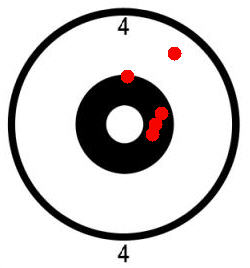
Here are the first 10 shots after a quick powder cleaning.  I actually made sure to really try for good grouping just to see how bad it would really be...The first two shots were the ones on the far right and the one that is just high and to the left of the 4 ring.  

I had hopes that after 10 shots that things would calm down a little bit.  Here's the next 5.
With all rounds printing inside the 4 ring, I was a lot more confident that things would steadily improve, back to where it was shooting before I cleaned it.  The next 5 rounds told me it was back to normal and time to rock and roll.


Please keep in mind that this cleaning regimen and these results are for a store bought sporting rifle, not a bench rest target rifle.  The serious target shooters have special regimens, break ins, cleaning routines, and voodoo ju-ju that are not required by a fun loving recreational plinker like myself.  

For my fun rifles, to get the most out of them as I can, I don't mess with the bore until it needs it.  

Don't mess with a streak.  
If it ain't broke, don't fix it.
If it groups well, don't clean it.

Only YOU know your personal groups and your personal averages.  Soon we will be getting into the Art of the Shot and some of my routine that may help you improve your groups a little.

Hey, if anyone has a suggestion that can help the masses or even a pointer that I can use in MY shooting, feel free to comment.  I am always open to try new methods and learn new things. 

My methods aren't always the traditional or the "right" way, they are more of a hybrid conglomeration of things I've learned through various sources that have worked well for me over the years.   

I always want to improve.  Always.  Never accept being mediocre if you are passionate about something.  


Accurate Marksmanship Pt. 4 Open sights vs Optics

     Just a quick recap, in Pt. 3 I discussed the different types of open or "iron" sights and their pros and cons when it comes to the "Precision" end of accurate marksmanship.

     The one thing that showed a negative effect on all three types was the fact that you are limited by your own eyesight, regardless of what types of open or iron sights are on your rifle.

     I wanted to demonstrate on paper, the difference in precision between an inexpensive magnified scope and the factory iron sights on my little Mossberg 702 Plinkster.  The sights on the Mossberg aren't too bad for what the rifle is, which is a very inexpensive "Plinking" rifle.  It's not designed to be a "precision target" rifle, but it is fairly accurate when you understand the ammunition and the limitations of the ammo as I discussed previously.

     Here is a pic of the "testing" grounds.  My backyard "Stumpilicious" range.  From my shooting position to the backstop/stump it is exactly 30m or 32 yards.  Due to the angle of incline I cannot shoot from the prone position without seeking medical and/or chiropractic attention afterwards.  I try to set up as "field expediently" as I can for realism in the shot process.  No sandbags or store bought "bench rest" equipment.  I shoot off of a backpack like a hunter or soldier might for as steady as a position as I can manage.


For a generalized idea of how it looks with iron sights, I tried my best to get the camera into a 7:1 zoom and took this pic.  I was trying to get the bulbous front sight post in the picture to show how it completely covers the 2" target from this distance.  If you pressed your nose against the screen, I did just now, too.


While I was attempting to get my shots in with the scope on, my groups quickly deteriorated into a big fat mess, so before I could continue I had to run the bore snake and some Hoppes #9 solvent through the barrel a couple of times and then foul up the barrel with about 15 shots before it was back into "precision" mode.  Fortunately, I kept all of my targets which will be used in the next installment of the blog.

Back to business.

Two 5 shot groups WITH optics.  I did change the magnification between the two groupings.  Both groupings gave me .75" groups.  (The 4 ring is a hair over 2" diameter, as an FYI)


I can live with 5 shot groups like these.

Moving on to the factory open sights.
Same rifle
Same shooter
Same ammo
Same bore conditions
Same distance
Same everything....except I take the scope off of the rifle and go strictly with the factory open sights.

Two 5 shot groups, Open sights.


That is a big difference, in my opinion.  Not that the rifle isn't accurate with iron sights, but the precision percentage just drops off the face of the planet.  These 5 shot groups went to 1.25" and 2" respectively.

Why? 
I am 39 and wear glasses, corrected to 20/20.  I see the target pretty good.  The target is somewhat small, being 2" on the 4 circle and the diamond is 2" top to bottom, side to side, so I'm working with 2" at 32 yards. 

The visualization of the target through coarse iron sights with a big "bulb" on the tip doesn't give me any opportunity to fix my sights WITHIN the target area.  I just have to put the front sight post over it, breath and squeeze and hope for the best.

With the magnified optic, I get a minimum of a 3x zoom and very fine crosshairs which I can try to control on a much smaller level, thereby gaining a huge increase of muzzle control within the actual target area.

I also wanted to show how a magnified optic with a good zero can really help with your shot placement over a rifle with iron sights.

These two shots were taken on a whim while trying to decide which brand of ammo was working better with the rifle on a previous shooting day.  These are with the scope.

  
Aiming for the very center of the Lucky Gunner shamrock, these are the results with a 3x scope.  Not bad.

It got very ugly at the same distance with the factory open sights.  I could barely even see the shamrock, let alone put a shot in it.  I put up a Lucky Squirrel and the Lucky Gopher just to see how it would go with open sights.

I took two shots at the squirrel, came over to the shamrock, then went and looked at my targets.  

My first two squirrel shots were in the tail, not hitting "body" and the shamrock miss was so bad that it actually made me a little bit angry at myself.  I don't like to miss that bad.  I went back to my table, loaded up 5 rounds and gave that squirrel a little bit of quick fire love.  


     Funny thing, the 5 shots of quick-fire love on the unlucky squirrel was probably the best 5 shot string that I shot that day with the open sights.  I didn't go through my typical shot routine, just tossed the barrel up, put the squirrel center mass in my open sights, and let loose.  

     In conclusion, with open sights vs. magnified optics, there's a fairly good reason why shooters opt more towards the scope as an upgrade over the target aperture and hybrid tactical aperture iron sights.  
Price.  My inexpensive little Tasco 3-7x20 scope is an $18 investment and as the results show, it is effective for the distances I am working within.
To gain that type of precision percentage with an upgrade of open sights you can spend as little as $10 for a different front sight post all the way up to hundreds of dollars for top quality target aperture sights.

As a quick summary of the rifle, scope, and ammunition used in this testing...

Rifle:  .22lr Mossberg 702 Plinkster
Scope:  Tasco 3-7x20 
Ammunition-CCI Blazer High Velocity 
(With the exception of the first Shamrock shot in the left leaf, that was Federal Bulk HV)
Range - My backyard "Stumpilicious" range.  30m/32 yards.

Targets courtesy of my friends at         http://www.luckygunner.com


Friday, August 16, 2013

Accurate Marksmanship Pt. 3 - Open Sights


     Let's talk about rifle sights for a few minutes.  I will get into magnified optics in the next blog installment.

     There are three types of open or "iron" sights.  Traditional "hunting" or "old school" style, target style, and ghost/post tactical style which are becoming more and more popular.

Let's start with the traditional open sights as these have been the standard since the musket days.  

Here is a picture of some different types of traditional open sights.

These are the same sights as on the Daisy BB guns that a lot of us grew up with and most pistols on the market are equipped with these in some shape, form, or fashion.

They are accurate when zero'd correctly to the shooter and once zero'd on the rifle for a certain ammunition, they probably won't have to be touched again for general purpose shooting.

These traditional sights can be as basic or as elaborate as you can imagine (or afford).  Some are merely three rectangular chunks of metal that you line up for your shot with the only adjustments being to the front sight post by using a hammer and brass drift to move left/right when the shots are not hitting center target.

Some have small knobs for easy traverse/windage adjustment and some are easily adjusted for elevation just by sliding something on the rear sight to the front or rear.  A good many of them, though, have to have a tool or coin to make adjustments.  That is fine at the range or when getting sighted in for zero, but if you need to adjust "on the fly" while hunting, it can make adjustments a major obstacle.

Precision with these types of traditional sights is mostly limited due to the larger front sight post or blade, especially the width of them.  Typically the thinner the front blade/post, the easier it is to precisely line up INSIDE of a target and maintain muzzle movement within the target.   A large post might completely block the target out of view so there may be no way to see your muzzle movement within the target at all.

     Pros:
Price/Value.  Typically installed on the rifle from the factory.
Accuracy at a known distances.
All weather.
Hard to knock out of zero.
Easily modified with glow paint for low light conditions.
Large area of view down range.
Ease of "snap" or "quick" shots.
   
     Cons:
Sometimes no easy adjustments or hard to adjust on the fly.
Factory front blades/sight posts tend to be too wide for precision accuracy at different distances.
Takes a lot of practice to master these at different distances, especially when there is no elevation adjustment.
Long distance shots with a lot of bullet drop can be almost impossible due to not being able to even see the target if there is no elevation adjustment.
Precision distance limited by shooter's eyesight.


Target - Aperture Sights
 
 Moving on to target sights which are called "aperture" or "peep" for the rear sights and "globes" for the front. This style sight has been around for as long as the traditional sights.  Target shooters saw the limitations of standard sights, especially the hard or impossible to adjust ones, and started developing sights which were easily adjusted for distance and wind conditions and very precise concerning sight picture.

Here is a picture of an Anschutz Target rifle equipped with target style aperture rear and globe front sights.

Here is a picture of some front aperture or "globe" inserts.  These are typically interchangeable for the front sight, based on the shooter's application, conditions, and preferences.


These aperture sights are the original precision sights and their benefits far outweigh the limitations with precision target shooting applications.  

     Pros:
Precision accuracy percentages-huge increase.  
Ease of adjustment.
Large selection of different peep diameters for the rear and different front inserts.  
Pricing is reasonable compared to scopes.

     Cons:
Hard impact could knock out of adjustment.
Very sensitive to light conditions.  Globe front sights sometimes very hard or impossible to see.
Takes time to go from a ready position onto gun and get a good sight picture making quick snap shots a challenge.
Precision distance limited by the shooter's eyesight.

     Ghost/Post Tactical style.  Small ghost ring sight in the rear, front sight post.  This is the standard iron sights for the U.S. Main Battle Rifle from the M1 Garand in WWII up through the M16/M4/AR family of firearms and also used in a lot of tactical submachine guns and shotguns. As a hybrid of target/traditional open sights, it makes a happy medium.  Target acquisition is much quicker due to a larger diameter rear sight ring (the ghost), and the front sight post is typically somewhat open (not enclosed in a dark globe) so it works well in lower light conditions.  Front sight post is easily changed out and can easily be adjusted up and down for zeroing purposes.  Rear ghost rings are sometimes a double ring, offering the shooter the ability to change the opening diameter for lower light conditions by just flipping the sight. 

Here is a picture to give you a good idea of what the front and rear sights look like and a small selection of different apertures and sight posts.  


This type of setup is becoming more and more popular in the sport shooting and hunting circles due to the increased amount of AR style weapons on the market.   This style is also becoming more prevalent in hunting/sporting rifles as well.

     Pros:
Good precision, depending on front sight post width/style.
Very durable.
Easy to adjust for traverse/windage
Easy to adjust for elevation/distance (in the cases where that option is on the rifle, as shown above).
Quick target acquisition, even in lower light conditions.
Large selection of front sight posts for different applications. Low $$ for upgrade.

     Cons:
Good precision, but not great.
Aftermarket upgrade for most sporter/hunting rifles.
Precision distance limited by shooter's eyesight.


Even though a shooter can really learn the open sight system on their rifle, they will certainly be limited on their precision based on their eyesight.  
Hitting a large target within your rifle's distance capabilities isn't too much of an issue with any of the three setups listed above, however your precision is directly affected by the three systems in one way or another. 

The one thing that fell into all three system's deficiency table....the precision distance is limited by the shooter's eyesight.    

     If Mother Nature (and my kids) allow it, I hope to get some data collected to demonstrate how much of a difference in precision, even at short range, that a magnified optic can have over some basic traditional open sights that might come on your rifle.

One shooter, one rifle, one ammo, one distance (30m/32yd), open sights vs. an inexpensive 3-7x20 Tasco magnified scope.

I should prepare myself, so off to http://www.LuckyGunner.com for some free targets. 


Tuesday, August 13, 2013

Accurate Marksmanship Pt.2 - Ammunition and the Rifle, some thoughts.

     In this series we are dealing primarily with the shooter's habits and knowledge, touching on some equipment and ammo thoughts.  One thing about me, as a shooter, is that I like to take the "underdog" approach.  I try to squeeze as much accuracy out of the rifle and ammo as I possibly can before considering any type of upgrade.

     Case in point, I use the least expensive store bought semi-auto .22 rifle on the market.  The Mossberg 702 "Plinkster".  No bells, no whistles.  Typically around $110-$120 brand new.  On top is probably the least expensive Tasco 3-7x20 scope that you can purchase for $18-$20 at the same store.

     Most of this series is geared towards shooting .22 rifles and .177 air rifles.  Why?  Because a very high percentage of firearm owners already OWN a .22 rifle.  It is the perfect beginner rifle and the perfect training rifle.  They are relatively inexpensive to buy, shoot, and maintain.  What about the .177 air rifles?  1000 rounds for $16-$18 sound good to you?  Quiet training, at night, when the kids are in bed.  I love it.

     "Beware the man with one gun, because he probably knows how to use it."  It's an old saying, but it is so true.  Consider the fact that quote probably came from latter 1800's, after the Civil War, when repeating arms became widely popular.  Lever action rifles shooting .45 long colt cartidges, cowboy style.  The trick is, they didn't have all kinds of ballistic knowledge at their fingertips like we do today.  They had to go out and get some serious work in to make sure they knew how their equipment operated at different ranges and under some extreme weather changes through the year.  If you spend enough time shooting your rifle, you will have an intimate knowledge of its personality and performance.

     So let's start by discussing the .22 rifle and ammunition.  One thing they all have in common is that they all shoot the same ammunition size.  You could own a $4300 Anschutz bench rest target rifle and it will shoot the same bullet/cartridge as the little $110 Mossberg does.  What you really NEED to understand about the .22LR ammunition is the different types of ammunition and their capabilities.

     Most .22LR owners will, at some point, purchase a box of "Bulk" ammo.  500 rounds, 550 rounds, whatever...a whole bunch in the box/case/carton, for a low price.

I use it all the time, but I understand what it can and cannot do.
I do NOT expect .22lr bulk ammo to group well beyond 45-50 yards.
I DO expect it to group well at any range out to about 45 yards consistently, and it does.
I understand that there will be some hot loads and some duds in the box.  It's the nature of "bulk" ammo.

     So many times people will take their inexpensive .22 to the range, load up with bulk ammo, shoot really nice groups at 50 yards, then have something that resembles a nasty shotgun blast when they stretch it out to 100 yards.  They blame the cheap rifle and/or the "cheap bulk ammo", but neither one of those is entirely correct.  It's not the equipment, nor the ammo's fault.

It's the sound barrier that made their groups ugly at 100 yards.  HUH?  How so?

     Most "bulk" ammo is H.V. or High Velocity.  That's good, right?  Faster is better?  It all depends on YOUR application.

     The bulk ammunition that I use shows a muzzle velocity of 1260 feet per second.  The speed of sound is 1127.92 fps at 70 degrees F.  At 50 yards, the bullet is going through the trans-sonic barrier....slowing down to below the speed of sound.   Air and turbulence make the projectile wobble, tumble, and all kinds of fun and unpredictable stuff as the bullet slows from supersonic down to trans-sonic.  The smaller the projectile (a .22lr bullet IS small), the more it is affected.  A 36-40 grain bullet is going to get beat up in this region a LOT more than a 165 grain bullet.

     Am I telling you that you won't be able to hit your target beyond 50 yards?  No, I'm not telling you that.  What I am telling you is that with high velocity ammo, don't expect a lot of precision beyond 50 yards with it.  Don't expect a 1/2 group at 60 yards.  If it DOES group 1/2" at 60 or 70 yards, FANTASTIC!

     How do those guys that shoot those tight groups at 100 yards do it?  They shoot SLOWER ammunition.  Sub-Sonic stuff which is typically in the 1065-1050 fps range.

Why that low and not 1125 fps?
Two reasons.  Reason #1  The speed of sound is not "constant".  It varies with air density which changes due to temperature.  The ammo manufactures typically test the velocities around sea level, at 70 degrees.  If I took ammo with 1100 fps to the range in the winter time, and it's 32 degrees outside...the speed of sound is 1067 fps, so I have the same issues.
Reason #2, not all barrels are the manufacturer's test barrels.  You will have different muzzle velocities from a 16" barrel vs. an 18" barrel.  It might not be a lot, but when dealing with the sound barrier, every fps counts.

1050 fps is good because the temperature would have to be ZERO F to be at the sound barrier for 1050 fps.

     How is a slower bullet more accurate at longer ranges?   The subsonic does not have to mess with the sound barrier and all of the wobbles/tumbles/unpredictability.  It will carry on it's ballistic path unmolested.  Gravity and air density/wind are the only things affecting the flight path.  Those things can be accounted and adjusted for.

     That little tidbit of knowledge can prevent so much frustration on range day.  The difference in price between a premium subsonic and "bulk" high velocity?
About .30 per round.
500 rds bulk/$20= 4 cents per shot.
50 rds subsonic/$18.75= .37 per shot.

     My suggestion?  Learn to shoot tight groups at short distances no further than 50 yards with the bulk ammo.  It's great practice stuff.  Non-frustrating IF you understand the limitations.  When you are consistently grouping 30-50 yards with the cheap stuff, then you can bump up to some premium ammo and stretch things out.  Those 30-50 yard groups are going to tell YOU how well YOU are shooting.  It doesn't make any sense to spend hard earned money on premium ammo if YOU the shooter are not doing your part correctly.   It'll be great ammo being shot poorly.

Remember the triangle of accuracy.

     Something else to note.  All rifles are NOT created equal, even two that come off the line right next to each other.  Manufacturing tolerances differ and quality control tolerances are not quite as stringent on mass produced firearms.  Rifles tend to "prefer" different types of ammunition.  Brand A might be the best that money can buy, but for some reason (deeply scientific, I'm sure) the rifle does not like to shoot it.  I see a lot of this with pistols, as well.

     True story...my nephew is shooting his Remington 597 combo.  He's loaded with brand X and his groups are nothing shy of UGLY and HORRIBLE at 25 yards.  This young man has some pretty good fundamentals, his papaw taught him well.  I watched every shot and every trigger squeeze.  They checked the scope to make sure it wasn't loose.  Checked the screws to make sure they weren't loose.  Everything was nice and tight, as it should be.  In essence, we did some troubleshooting on the equipment and since I had seen that the shooter's fundamentals were good, it eliminated the shooter and the equipment from the triangle of accuracy...I loaded him up with a magazine of the ammo that I was using and his groups went from 6" diameter down to 1.5" diameter....just with an ammo change.  That is a massive difference.

     We cannot condemn the ammo manufacturer for the stuff not shooting well out of his rifle.  His rifle just didn't like it.  It happens, especially with semi-autos.
     How in the world can I find out what my rifle likes to shoot?  Trial and error.  If you have friends, do some 10 round trade-offs.  They have brands A and B, you have brand C....everybody trades off 5 rounds to each other and end up with 5 rounds of each brand to try out.

     Something else to make note of.  Do not expect your rifle to shoot the same after the barrel being cleaned!  I will certainly be doing a demonstration of this sometime soon, but when you put anything down the barrel of your rifle, it is altering the dynamics of the bore.  Am I telling you NOT to clean your barrel?  No, but I AM telling you not to EXPECT your point of impact to be the same as it was before you cleaned it.  Johnny shooter goes to the range, puts some awesome groups on paper, goes home, cleans his rifle and makes it perfectly spotless inside and out, taking exceptional care not to bump the scope or anything.  Goes back to the range the next weekend, brags to his buddy how his rifle is shooting so nice.....and then cannot get his first 15 shots even remotely close to where he was zero'd.

"If it ain't broke, don't fix it."  
"Don't mess with a streak"
"If it's hot, don't touch it"

     When you are dialed in, think about those three quotes, because rifle barrels fall into those categories.  It is ok to clean the outside and in the chamber, the bolt, etc.   Stay away from the inside of the barrel unless you just like to foul and re-zero your rifle every time you go shooting.

"When SHOULD I clean it?"
1.  Whenever you get sand/dirt/foreign substances into the barrel.
2.  When it's extremely humid or raining and you didn't have your muzzle/barrel protected from getting moisture in it.
3.  You notice your groups start to open back up again.  Your 1/4" group is now a 3/4" group and getting worse.
4.  You shoot old or corrosive surplus ammunition.  Powder/propellant recipes these days are so much cleaner than they used to be.  Use older ammunition, clean it spotless every time.
5.  If you notice any rust starting to form in the bore/barrel.  See #2.  Moisture can get you when you least expect it, even in your gun safe.  It makes VERY good sense to do a visual inspection every week or two, religiously, just to make sure.  Don't forget to wipe off those KFC greased fingerprints when you put it back!
6.  A shotgun is NOT a rifle, clean it every time you are done shooting it, even rifled barrel slug-guns.
7.  Military/AR applications. Direct impingement AR-15 and M4/M16 varieties.  These are gas operated rifles and introduce a TON of carbon into the chamber and throat areas of the weapon.  If you want it to work properly when your life is on the line, clean that sucker spotless x3.  Spray carb cleaner and keep cleaning it, if you don't bend at least 1 dental pick, you are doing it wrong.  Your buddy depends on you.  Enough said.

But Claymore, you didn't say a whole lot about the actual rifle.  There are so many .22 rifles out there...
Exactly.  I mentioned how inexpensive my personal rifle is, and how expensive an Anschutz can be.  It is virtually impossible to really get into too much depth as far as the actual rifle is concerned, except for the fact that all rifles are NOT created equally and that most rifles have a personality all of their own.

Here is what I CAN tell you about any rifle that is new to you....

Store bought, brand new:
     Take it home and clean it, inside and out, especially the barrel, bolt, and chamber areas with a mild solvent like Hoppes #9.  A bore brush or bore snake MULTIPLE times and use a synthetic bristled tooth brush in any cracks and crevices around the chamber area.  Rifles are not pristine when they are shipped from the factory.  There are lubricants and preservatives coating the inside and out to prevent any rusting while it sits on the shelf of the factory/trailer/store.  There are also leftover remnants from the manufacturing process that could use being cleaned out of there.  In essence, spit shine it before you shoot it.

Pawn shop/Gun show purchased, used:
     Same as store bought, brand new.  You probably won't have to be as aggressive, but chances are good that there is a larger coating of oil than is needed which will collect dust and particles, etc.   Better safe than sorry, clean it, then shoot it.

Heirlooms:
     Your grandfather bought it, shot it, took care of it, then your mom/dad, and now 40 years later it is yours. Do some research, you may not even WANT to shoot it a lot, but if you do, run a bore snake through it once or twice with mild solvent, give it all a good wipe down, but be careful with the "furniture", because every spot and nick in the wood probably has a family story to tell and you may know those stories.  Enjoy your history and take care of it like no other.  Hand it down to a family member and tell those stories to them.  Maybe it will make another generation or two down the line.

Surplus & Historical:
     Cosmoline, cosmoline, and more cosmoline.  Prepare yourself for the icky sticky mess.  Watch some youtube videos, about cleaning cosmoline, etc.   Even if you purchase one that has "been cleaned", it could be YEARS before all of the cosmoline/preservatives are out of the woodwork.
It's an old military rifle, it shot old military ammo which was corrosive and probably even came with some old corrosive ammunition.  Military is what it is.  Clean it spotless every time.
When you get done with the corrosive ammo, clean it one really good time (Windex is highly recommended for EVERY cleaning that involves corrosive ammo) and then move on to new ammunition and stick with it, even though it may be more expensive...unless you just like the smell of Windex.

     New rifles come with an owner's manual.  Used ones typically do NOT.  I recommend researching the manufacturer's website and also Youtube for basic and advanced operation of the rifle as well as dis-assembly, reassembly, and function checks.  There should also be information for the rifle as to dealing SAFELY with malfunctions and failures.  This is extremely important.  Safety is ALWAYS the key.


Quick Recap:
1.  Don't blame the rifle or your choice of ammo for sound barrier issues.
2.  Don't blame your rifle for shooting poor groups or losing zero if it is spotless and clean.
3.  Don't blame the rifle if your fundamentals are good, it could just be the rifle doesn't like that brand of ammo that you are feeding it.
4.  Inexpensive "Bulk" ammo doesn't suck, it just isn't great for any type of precision accuracy beyond 45 or 50 yards due to being high velocity.  It is a great way to "break-in/condition/season" the barrel inexpensively and learn to shoot precision shot groups within 45 yards.
5.  Inexpensive rifles can be precise and a lot of fun to shoot, if you give them half a chance.

Next up in the blog I will talk a little bit about iron sights vs. magnified optics and what you can expect out of each and why.


Monday, August 12, 2013

Accurate Rifle Marksmanship - Pt. 1 An Intro to Shooting with Precision and Accuracy.

Ok gang, back to the main reason for my little blog.  Creating a better rifleman.  Let's get on track.

I have mentioned in a previous post about the "Big Three".  The Triangle of Accuracy being the shooter, the ammo, and the equipment.  When all three of these are lined up, accuracy, at a certain range, WILL happen.

Being accurate is good, but it is NOT good enough for me.  I like to be as precise as I can with my shots.
Let's take a quick look at three pictures and you will see where I am going with this.

Picture 1 - Accuracy.
Each square on this ballistic target is 1".
You go to the range, sight in on the target, and take 5 shots.  These are your results.


Hey, not too bad.  Every shot is within 1.75" of your point of aim.  Let's move on.

Picture 2 - Precision.

We are still about 1.75" away from the point of aim, but our group is much more precise than the shotgun blast looking thing on the first picture.  

Picture 3 - Precision Accuracy.

This is what we want to eventually achieve.  5 shots, in the black, at your point of aim, close together. 1/4" to 1/2" grouping.  


How do we get there?   That is the big trick, isn't it?   Shooter/Ammo/Equipment, that's how.  

Let's look at Picture 1 compared to Picture 3......from a different point of view.
Same shooter shot both of them.
Picture 1 - Shooter was standing up, no support.
Picture 3 - Shooter was in a prone or bench rested position and the rifle was supported on sandbags.

What's up with picture 2, then?  That was some nice shooting!  I agree.
Shooter was same shooting position as in picture 3.
Picture 2 could be any number or a combination of a few different things.

1. Rifle not zero'd to shooter. 
2. Different ammo than zero'd initially.
3. Same ammo, new box (different LOT#).
4. Steady 7 O'clock wind at 12-15 mph not accounted for.
5. A group this tight shows that the shooter knows what they are doing, so it is either equipment, ammo, or environment.


Let's take a look at 3 more pictures.  Shooter is a precision shooter, great fundamentals but limited understanding of ballistics.  3 round groups.

Group 1 - ..22 Rifle - Zero Range  35 yds.

Group 2 - Same everything, target now at 10 yards.

And lastly, same everything, target at 75 yards.


How is it that the shooter is LOW at both 10 yards and 75 yards, but dead on at 35?

It is all about ballistics.  Bullets are not laser beams.  Bullets do not travel a nice elliptical arc to the target.  
Gravity, bullet speed, air density, and drag coefficient all play a large part on the travel of the bullet.

Have a look at this chart.  It shows a 35 yard zero with two different types of ammo for a .22 rifle.


As you can see by the graph, the point of impact will be low, then right on target, then drop again.  It is all based on the range that the rifle is zero'd.

Same rifle, same ammo, with a 50 yd zero...


Notice how from about 22 yards to 50 yards how the bullet impact is ABOVE the target, and from 50 yards out to 100 our point of impact just drops like a stone?  


The shooter HAS to adjust point of aim based on the range of the target to maintain precision accuracy at ANY range.   

Being a great bench rest 100 yard shooter is fine....if you are only ever going to shoot groups at 100 yards, from a bench rest, at a range.  Same shooter takes his/her rifle out squirrel hunting and anything between 11 and 100 yards is going to be a high impact, up to 2.75" high at 58 yards.  

These are all things that we will address and learn to correct for.

But first thing is first.  If we are going to have any semblance of precision accuracy, we HAVE to work the fundamentals in our shot, otherwise we can throw shot placement and consistency out the window.

We will primarily be dealing with the aspects of the shot itself, but I will also speak about ballistics a little bit because that deals with the point of impact upon the target and all of the things that can affect it while the projectile is in flight.

Some links that I think will help you out considerably as we go into this series...

Sniper 101 Series by Matt Tibor - The Tiborasaurus Rex.  I am a very competent shooter yet my knowledge base has expanded exponentially since diving into this series.  This series primarily deals with extreme long range shooting, however, we get into the science of the shot from every angle.  Information galore.  You will learn, Rex will teach you.  

LuckyGunner.com - We purchase all of our pistol ammo from Lucky Gunner.  Yes, you can purchase ammunition online and have it shipped right to your door.  How cool is THAT?  If you don't see it listed on the website, it's not in stock.  If you see it listed, it's in stock and ready for you to buy it.  It's that simple.  Every order that we have had has been flawless.  
It's not just ammunition and gear, though.  The Lucky Gunner Lab does very extensive testing and they put their findings out there so that the customer can be more informed.  
They also have free targets that you can print out.  You'll notice the targets that I work with are the Ballistic Target and we will also be dealing with the Lucky Gopher and Lucky Squirrel as well as the Trouble Shooter and Silhouettes.   I highly recommend them.  (As of this second they have a ton of .22lr ammo in stock, if that tells you anything).

I currently use these FREE ballistic calculators. They are very handy when dealing with drop and windage for different ranges.  

I use the Hawke BRC on my desktop and the mobile version on my Kindle Fire.  

I use the Ballistic Sim program a lot just due to ease of use and comparison while at the office.

JBM Ballistics.  This has been one of the premier online sources for running web-based ballistics for quite a while.  I doubt that will change.  I use this one a lot for getting spin drift and coriolis corrections.
JBM Ballistics Calcs

There are countless other good ones out there, like GSeven, but I don't have a lot of experience with them...YET.

Up next in the blog...setting yourself up to succeed and learning/re-learning the basic fundamentals.
Thanks for reading and I hope you read again soon!

Thursday, July 18, 2013

The Curve Balls of Life

     Life throws us all curve balls.  It is a constant guarantee, just like death and taxes.  My mom passed away in late April at the age of 75.  Her health had been less than desirable for the past decade and the past couple of years have been the roughest.  A burst abdominal aneurysm, thyroid problems, pancreatic issues, blood sugar issues, you name it.  She had a rough go of it, but spent the past year doing quite a bit better until she fell.  The constant pain of a hip fracture mixed with everything else really did her in.  She had a good life and went out on HER terms, which is more than a lot of people can hope for.  That's all I've got to say about that.

     A baseball pitcher will exploit a batter's weakness.  Hence, the curve ball.  Mr. Murphy has a tendency to do that to us as well.  Mom passes away, the company that I work for is in a precarious financial position and has filed a Chapter 11 bankruptcy, my trusty steed "SuzieQ" died and went to car heaven which leaves us being a 1 vehicle family right now, and to beat it all, my lawn tractor (a 22yr old Simplicity) is giving me a ton of grief and the engine has probably given up the ghost.  I live for a good challenge, but things have been absurd over the past few months, ergo my lack of any recent blog posts.  

     All things considered, I am still getting to try some weapons out that I've never fired before, I'm trying to stay "in practice" with my air rifle but I'll admit that I am not shooting as much as I would like.  It's not that I haven't had the opportunities, but maybe I have just been slacking off.  It's time to get back into the saddle and do some writing and certainly some more shooting.  

Let's update some things that have been happening in my literary absence...

  1.  I am up to 63 shots through my 7mag.  She's getting closer to copper equilibrium.  I'll be taking her to the range this weekend and making sure she hits paper and try for some groups at 100 yds.  The only way to tell if the barrel has truly hit the sweet spot is with a shooter's chrony, which I do NOT have access to at the moment.  Just judging by the shot count, she is probably within 20-40 shots of a consistent muzzle velocity.  I have two purchases that I need to make sometime in the next 5 months.  A shooter's chrony and reloading equipment.  We'll see if my time frame holds true with the current financial burdens we already have.

  2.  Something is up with my pistol shooting technique.  In all actuality, I can't hit SHIT unless I shoot one handed right now.  If I go into my modified Weaver's stance, the chances of me hitting the target are about as good as winning the power ball lottery.  With ammo prices the way they are, and the way that I personally feel about pistols (a weapon to get you out of a jam and buy you time to get a shotgun/rifle) I haven't had a chance to work out the issues.  Maybe I should go with a CO2 air pistol for practice?  It is certainly something to give extra thought to.

  3.  I recently purchased an old (mid 80's?) Marksman 1790 for my oldest daughter (12).  It is a break barrel, single shot, spring piston, pellet rifle.  I spent a whopping $15 for it.  I stripped it down, painted the metalwork fluorescent pink, and fabricated a new leather breech seal for it.  My best guesstimate is that it shoots around 450-500 fps and is actually VERY accurate in the 10 meter (32ft) range...which makes it AWESOME for my carport range.  It has a rear peep sight and a globe front sight.  

  4.  My oldest daughter suffers from the same eye dominance issue that I do....we are both CENTER dominant.  Center dominance creates an odd challenge for a shooter, especially when peep sights, ghost rings, and optics of any kind are introduced.  Right or Left eye dominant shooters can leave both eyes open and focus through their sights with their dominant eye without any issues.  Center dominant cannot do that.  The focus of the target in our sight picture will just **poof** disappear.  Two easy ways of fixing the issue....close the non-shooting eye or wear a patch.  My daughter cannot physically close her non shooting eyelid.  It's quite funny to watch her try.  I guess that she never trained those muscles to work independently of each other.  I purchased a black eye patch, pirate-style but no skull and crossbones.  We painted it white and then painted a red-cross on it.  Think "Kill Bill".  It's awesome and now she is shooting considerably better.

  5.  My little .22 lr, a Mossberg 702 "Plinkster" could gain A LOT more precision accuracy with the purchase of new front and rear sights.  The factory sights are not bad at all, but for real precision they are too bulky.  My backstop at home is at 32m (105 feet).  When I put a 75' small bore target up there, the front sight post completely covers the target circle. This is fine, because I am shooting entirely in that circle...but the circle is 2" in diameter.  So at 105' every shot is going into a 2" circle with open sights and I am complaining???  Damn skippy.  I think the biggest issue is the front sight post.  It has a tiny ball on it.  If it were a thin blade I could center it within the target circle and have MUCH tighter groups.  "Why not put a scope on it?".  I had one on there and took it off.  I just really like open sights on certain rifles and the little mossy is one of them.  

  6.  Since by blog absence I have gotten the opportunity to shoot a Browning SA-22, it is a "take down" model that breaks down into two pieces by unscrewing a castle type nut at the base of the barrel and receiver.  It is an internal stock "tube" magazine with 11 rd. capacity, semi-automatic, bottom ejection, .22lr.  It is an heirloom rifle owned by one of my good shooting buddies.  It was his grandfather's gun and has been kept in fantastic shape.  I really enjoyed shooting a brilliantly engineered piece of history that still performs flawlessly.  It is an absolute tack-driver, a real pleasure to shoot.  

  7.  Mosin-Nagant.  7.62x54r, bolt action defender of the "Motherland", iron curtain style.  My same buddy who owns the SA-22 got a Mosin for his wedding anniversary.  The furniture is in really nice shape, as is the rest of the rifle.  I'm not sure which model it is, but it's a fun rifle to kick around with.  We will see how it does on the 100 yd range that we're going to this coming weekend.  I'm excited to see!  

  8.  Remington R1   .45acp 1911 style full-frame pistol.  Nice gun!
  
9.  Beretta PX4-Storm  .40 cal Sub Compact.  Another nice gun although my buddy recently traded it for...
10.  Para Ordnance LDA .45acp light double action 1911 style with a 4.5" barrel and is somewhat more concealable than a full framed .45 1911 styled gun.  

11.  Sig Sauer P238  .380 single action compact "pocket" pistol.  It's not much larger than a Ruger LCP or KelTec .380.  Nice little handgun.

     I think that's about it for things I've been fortunate enough to get some trigger time with over the past few months that I have been away from the blog.  My buddy and I are going to the range this coming Saturday and should get some quality work done with the rifles.  I don't know if we'll have much of a range report when we're done, but we should have a ton of fun seeing how our rifles act at distances beyond the 32 meter stump in my back yard.


Wednesday, April 24, 2013

Why is the sky Infantry Blue?


Q.  Why is the sky Infantry Blue?


     Sky blue is the color of the U.S. Army Infantry and the grunts wear it with pride. It was officially designated to the current configuration of the Blue Cord and Insignia with backing blue disks back in 1952.

     So now that we have the "official" mumbo-jumbo out of the way, let's get down to what it really is.  When a grunt "Turns Blue" he is officially indoctrinated into a brotherhood.  Receiving the Blue Cord is only the beginning for the Infantrymen and they won't really learn the full scope of what that cord means until they have spent some time as a grunt.

     You can take a man out of the Infantry, but you can NEVER take the Infantry out of the man.  The seeds have been planted and there will always be a spot deep in a grunts soul that glows true blue.  Sure, there are little rivalries within the Infantry units.  It's Esprit de Corps.  The fact of the matter is that there is a deep respect between those guys and there always will be.  There is also a healthy respect between the Army grunts and the Marine Infantry.

     Infantrymen have gotten a reputation since the dawn of time as being cocky, arrogant, stubborn, obstinate, relentless, A-type, and even sometimes barbaric.   I have to agree with most of these assessments, as would most grunts.

     What some would consider to be as "less than desirable" traits, the Infantry embraces, even encourages and enhances.  When the chips are down and losing is not an option, you have to be this way.  The infantry is life or death and in order to win, the team has to have a "win at all costs" mentality.  Never quit.  Never leave a buddy behind.  Intestinal Fortitude, the courage to continue in the face of extreme adversity, when others would fail, we shall succeed, together as brothers.

     From day 1 a grunt is trained to kill the enemy, by any means necessary.  Eliminate the competition with extreme prejudice.  That's our #1 priority, our mission, our goal, our purpose.  Two grunts will talk about the Spirit of the Bayonet with smiles and laughter, whereas any civilian or non-combatant type would be taken aback and SHOCKED at what they have just heard between those two guys.

     This IS the main reason why the Infantrymen gets a bad rep sometimes.  We volunteered for what you abhor.  We do what you will not do. We volunteer to be the primary defensive weapon and the defining offensive weapon for the United States of America.  We are the tip of the spear for democracy.  You can drop all of the bombs you want, you can drive through towns with tanks, but that ground is NOT yours until the grunts kick the doors in and secure it from all enemies, foreign and domestic.  The timid and/or faint of heart NEED NOT APPLY.

     What the typical citizen would consider as abysmal and sub-standard living conditions, the Infantry calls "home".  When the grunts operate and patrol, especially for long periods of time, there's no running water for a daily shower.  Rarely is there going to be decent shelter from the elements or enough food and water.  When it's the absolute nastiest weather and in the dark of night, during the time when everyone just wants to be warm and dry, snuggled in their beds, there's a squad of grunts out there in the miserable wet and cold, getting ready to kick the doors in and bring bad ju-ju upon the enemies of the United States.

       "I live near an Infantry regiment and all they do is cause trouble and get the local girls pregnant!"  There's a lot of truth to that statement.  Grunts in garrison are like junkyard dogs.  We train like animals to fight like the beasts you expect us to be when you call our number.  We are always preparing our minds and bodies for war and conflict.  It may never happen for us, but we prepare for it daily.  We live for the adrenaline rush, we're junkies for it.  We like to ride around in helicopters, jump out of airplanes, ford rivers, blow stuff up, shoot-move-communicate.  We do PT 5 or 6 times a week, and a lot of us hit the gym after "work" as well.  We clean our filthy gear until it is spotless and ready to get dirty again tomorrow.  When things "slow down" and the adrenaline rushes start to dwindle, that's when the grunts get into trouble around town.

     We let off steam by finding our own adrenaline rushes.  We live a life of extremes and are expected to be hard-core members of hard-core teams.  A fire team of single grunts on the town (especially when overseas) is a particularly dicey proposition.  4 or 5 guys who are trained in hand to hand combat and LOVE to be destructive who are out having several "cold 'uns" can only lead to trouble.  Is it right?  No.  Just consider the fact that they ARE what they ARE, and chances are good that they're single and "un-domesticated".

     Single grunts without kids are severely lacking in patience.  Heck, even grunts WITH kids are lacking in patience sometimes.  We work alongside highly motivated and truly dedicated people.  Half-assers, slackers, and non-hackers tend to try our patience.  "I can't", "I won't", "It is too hard", and "Impossible" are phrases and words that we have SEVERE issues with.

     We bitch and whine, we do.  What separates our bitching and whining from "the usual" is that we do it so that we can then tell each other to suck it up and drive on.  No matter how bad it gets, you bite your bottom lip, you suck it up, you drive on.  We continue the mission, regardless of the conditions.  It may suck, but we try to embrace the suck.  Tell us to move a mountain and a platoon of grunts will bitch and complain like you have never heard before....while they break out their E-tools and pioneer tools and get to work chipping away at that mountain.  While shoveling we will probably come up with a plan to somehow "liberate" a big machine and some explosives in order to complete the mission in a more expedient time frame.  We will improvise, adapt, and overcome....especially if it makes OUR lives easier.  We live for the "Can Do" attitude and we promote an "I can do better" attitude.  We like free thinkers who can think on the fly and come up with lots of good options to do things with better efficiency if at all possible.

     Some may think that the typical Infantryman has a lower I.Q., is less "educated", and/or less motivated mentally than the average soldier or even civilian.  This is SO far off base and incorrect.  There is a huge mix of intellect in the infantry.  If you were to compare the average ASVAB GT scores, you'd find that grunts have an average GT score on par with the aviation crowd and the technical crowd.  Just like anywhere else, there are smart ones and some that can be found "lacking".  Another thing to keep in mind is that 1 in 4 people who take the ASVAB test will FAIL.  I served with MULTIPLE enlisted men who had 4 year college degrees but did NOT want to become officers until they had done plenty of time "on the line".  I also served with many who did correspondence and college courses while enlisted and then attended OCS.

     One thing that the grunts have in common is a willingness to serve their country and to sacrifice anything and everything in the defense of this great nation. Predominately a bunch of guys who want to get paid to do things that the average "high speed" civilian would have to pay big bucks to do.  Firearms aren't cheap, especially when it comes down to fully automatic ones.  Hiking, mountaineering, riding in helicopters, rappelling out of them, jumping out of airplanes, riding around in Hummers, APCs, and BFV's are things that most "normal" people don't even WANT to do.  We live for it.

     We are adventurous spirits who typically possess abnormally high standards and work ethics.  We are sore losers because we cannot stand failure or sub-par performance.  We embody the importance of Standard Operating Procedures and excel in the gray areas between black and white.  We love to meet things head-on, but beware our brothers who are coming at your flanks.  We give everything we have to win, and then we'll give out our own supplies to those that need it more.

     It is funny (to us) how some people are shocked at "Blood Ranking" or receiving certain awards/achievements by way of blood.  Hazing is nothing new to the infantry.  A lot of it is done with brotherhood and love, although some forms of hazing is even considered by the grunts to be stupid and dangerous.  We do NOT consider blood ranking or earning blood anything to be stupid or dangerous if it is done in the proper way.  A lot of platoons and squads with good leadership will NOT allow a full blood line...but walking a team/squad/platoon gauntlet IS considered appropriate and even though you may not witness it at an "official" ceremony, chances are good that there is an "unofficial" ceremony that you will NOT see.  It's a right of passage in the Infantry.  I do not condone it anywhere else because your feelings might get hurt or you might be offended by having something pounded into your shoulder/chest.  There have been times that even I consider to be "rough" where I have thought back and remembered the sense of pride that I received when my 1st Sgt shook my hand and pounded something I had earned into me.  It saved my bacon on MORE than one occasion.  I don't expect anyone to understand unless they have been in those boots before, but those that have been there will certainly know what I am talking about.  Those that "don't get it" are typically frowned upon as "POGs", "REMFs" or civilians by the infantry and deemed "not worthy" of the argument.

     I don't expect anyone other than my fellow grunts to understand this.  Their families do to a certain point.  Being infantry is a calling, similar to those in medical or care professions.  It's a dirty job that not everyone is capable of doing nor even willing to attempt.  It's hard on the body and it's extremely hard on the mind.  There are times when every one of us wanted to quit, but reached deep down inside and kept going.  We live in the suck, we embrace the suck, and when there's a high magnitude of sucktitude a grunt is in his elements.

     The next time a nasty storm blows your way and you weather it out in your office or home, just remember that there's a bunch of grunts out there, standing guard or on patrol, 100% of the time, for your benefit.

     They're in their element, and when the skies begin to clear and the clouds part, that cold and wet grunt can look up and see the sky.  A little touch of relief for those on watch.

Blue skies = less suck.  

A.  The sky is blue because God loves the Infantry!


As a side note, even semi-barbaric grunts have a heart.  We love...not necessarily in any type of order...

Combat Medics and Medical Corpmen (Big time! Mess with our "doc" and shit just got real ugly, real fast for you. We will fuck you up beyond all repair and enjoy doing it)
Chicks (chicks dig grunts, too)
Music  (tames the savage beast, prepares us for an assault, drives out dictators from mansions)
Catching a ride (any ride, as long as we aren't walking it doesn't matter)
Preemptive Naming of any sport that we play as "Combat" (due to the inherent violence that will take place in lieu of rules.)
Accurate Meteorology (embrace the suck)
Accurate Intelligence  (big-time oxymoron)
Close Air Support (it damn well better be accurate!)  Specter, 'Hogs, Snakes, Apaches, just deliver it....
Food  (we burn 3x-4x the calories as the average person, feed the beast)
Beer  (we drink 5x-6x the normal weekly intake for an average person  in one evening, before 8pm)
Grandmas  (they probably have grand daughters who love grunts)
Little Kids  (future grunts?)

We pretty much have a disdain for everything else that isn't "grunt" related, especially non-Infantry Marines, Cav Scouts, MP's, and POGs/REMFs in general.

"I am the Infantry, Follow Me!"